

SOMETIMES LUCK HAS NOTHING TO DO WITH IT
In 1984, a man named Michael Larson went on the game show Press Your Luck and proved that when it comes to winning, sometimes luck has nothing to do with it. The premise of the popular game show was that by answering trivia questions, contestants earned “spins” on what was known as the Big Board, a ring of 18 squares that rapidly lit up in a seemingly random sequence until the contestant stopped the lights by pressing a button. Each square offered the possibility of a prize, but also threatened the chance of a “Whammy,” a small animated creature who eliminated any accumulated winnings...and laughed mockingly while doing it. Over the lifespan of the show, the average contestant took home around $10,000.
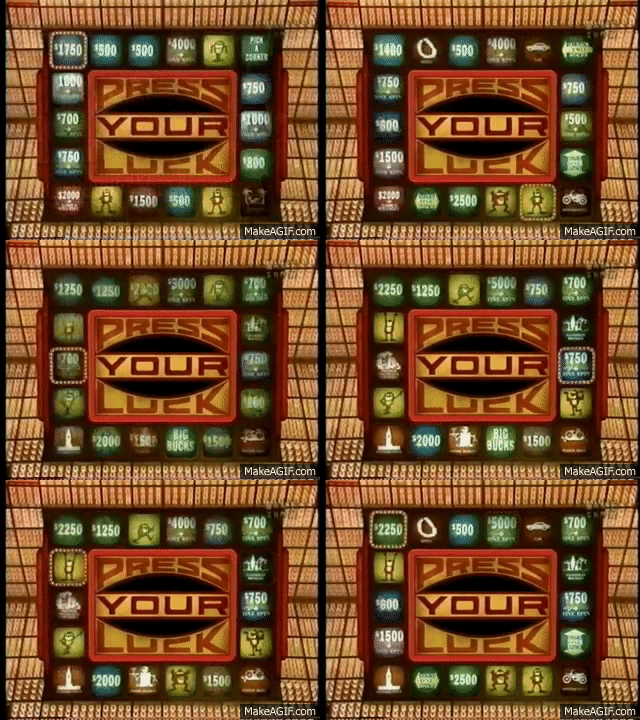
The lights on the Big Board flashed quickly, of course, which led most contestants to simply pressing their button - and their luck - and hoping for the best. But watching the show from his home in Ohio, Michael Larson noticed over time that the board didn't seem to be as random as it appeared. He bought a VCR, started recording episodes, and studying the film. He discovered that what appeared to be a randomized game board was actually only five unique, predetermined patterns of lights. Winning, he found, wasn’t an accident. It simply required a deeper level understanding of the choices, the patterns, and the strategy that ultimately led to the outcome he was after.
Larson spent the next few months recording episodes and committing the patterns to memory. He used the pause button on his VCR to practice his timing and hone his skill. Then he flew to California and auditioned for the show. He was selected, and on May 19th, 1984, played Press Your Luck alongside two other contestants - a baptist minister named Ed and a dental hygienist named Janie.
In the first of two rounds, Larson’s correct answers earned him three spins. He used them to calibrate the timing of his button presses. Ironically, three spins in, Larson found himself in last place. As the second round started, he earned seven more chances, and - now prepared - he put his winning formula to work.
Spin after spin, Larson successfully earned himself more money, more prizes, and more chances to spin again. Over and over again, he followed the formula, executed the plan, and won. 10 straight winning spins. Then 20 straight. Then 40. His prize money climbed to $20,000. Then $50,000. Then $100,000. Behind the scenes, game show executives were scrambling. Sweating. Swearing! Convinced Larson was cheating - but with no evidence to prove it - they were forced to let him continue.
Finally, Larson felt his focus start to wane. After mis-timing his mark (but luckily avoiding a Whammy), he passed his remaining spins to the dental hygienist, who finished out the game. After 47 spins on the Big Board, Michael Larson had won cash and prizes totaling a record $110,237. Ed the minister left with a little over $11,000, and Janie the dental hygienist, whose last spin tragically turned up a Whammy, left with nothing.
I tell you the story of Michael Larson’s record-breaking Press Your Luck performance today because I think it offers a unique reminder for each of us who say we want to win in some important area of our own lives. The truth is, it’s easy for anyone, including each of us, to do what most of those game show contestants did: show up and hope for the best. But Michael Larson’s unique perspective allowed him to see things differently, and therefore take a more strategic approach. He saw that winning was in fact not random, and that if you're really paying attention, success leaves clues for those who are willing to find them.
I want to challenge and encourage you here today to take Michael Larson’s approach to the success you’re pursuing. That starts by studying those who’ve been where it is you want to go, and using their example to clarify a winning game plan for yourself. Stop hoping for the best, and start building a deeper level understanding of the choices, the patterns, and the strategy that ultimately lead to the the successful outcome you say you’re after.
In the end, game show executives had to tip their cap to Michael Larson, and reward him the prizes he’d rightfully earned. He didn’t cheat, they concluded. He had simply done the hard work that no one else was willing to do, and in doing so had moved winning from a random chance to a likely outcome. When people study your success - and the clues you’ve left behind - may they say the same about you. That when it comes to winning, sometimes luck has nothing to do with it.